
The 4D's of Angel Investing
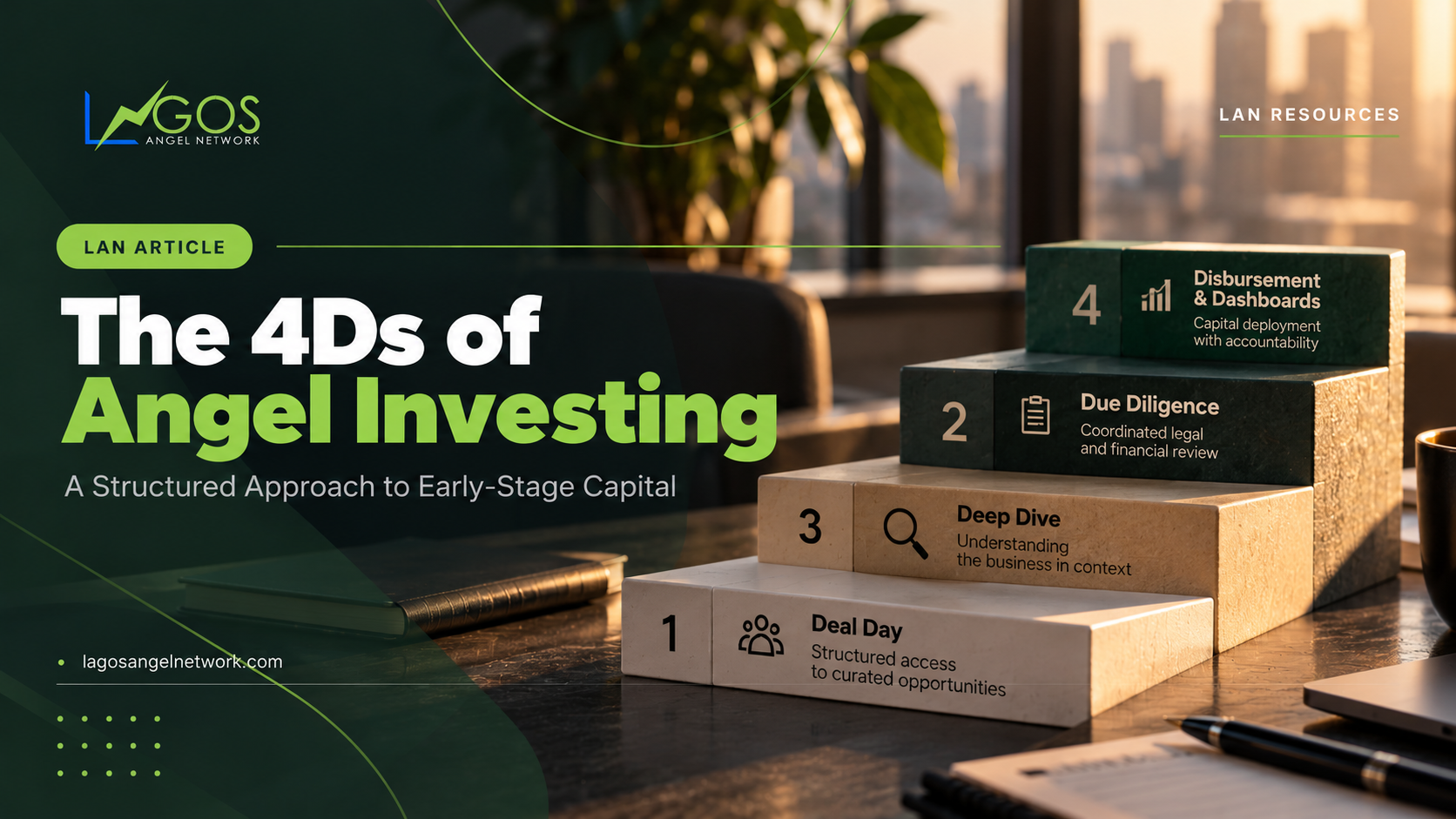
The 4Ds of Angel Investing
A Structured Approach to Early-Stage Capital
In early-stage investing, “due diligence” is often treated as a single event, a box to be checked before capital is deployed. In reality, effective angel investing requires a broader, more continuous process.
At the Lagos Angel Network (LAN), we think about diligence as a sequence of deliberate stages that extend well beyond document review. Over time, this has evolved into what we describe as the 4Ds of Angel Investing, a framework that reflects how high-quality early-stage decisions are actually made in complex, fast-moving markets.
These four stages ensure that investment decisions are informed, collaborative, and accountable from first exposure to post-investment support.
1. Deal Day
Structured Access to Curated Opportunities
The investment journey begins with Deal Day, a structured forum where selected founders present their businesses to a curated group of angel investors.
At LAN, Deal Days are designed to prioritise clarity over performance. Founders are expected to articulate the problem, solution, market opportunity, traction, and economics with precision. This stage is not about closing capital; it is about signal generation, identifying opportunities worthy of deeper engagement.
By curating both founders and investors, Deal Days create efficient early filtering and ensure that attention is directed toward ventures with credible potential.
2. Deep Dive
Understanding the Business in Context
When a startup generates sufficient interest, the process moves into a Deep Dive.
This stage involves a structured examination of the business beyond the pitch: product functionality, business model logic, customer behaviour, operational risks, competitive landscape, and team dynamics. A deal lead is assigned, domain expertise is brought in where necessary, and assumptions are stress-tested collaboratively.
The objective is not to eliminate risk — early-stage investing is inherently risky — but to understand risk accurately, in context. This phase often surfaces both hidden strengths and non-obvious vulnerabilities that would be missed in a purely surface-level review.
3. Due Diligence
Coordinated Legal and Financial Review
Only after a startup has passed the Deep Dive does it enter formal Due Diligence.
This is the stage most commonly associated with DD: legal documentation, financial disclosures, cap table review, and term sheet discussions. At LAN, due diligence is conducted collaboratively. Findings are shared, questions are coordinated, and investors move as a group rather than in isolation.
This approach reduces duplication, improves consistency in decision-making, and allows founders to engage with a clear, unified investor process. It also reinforces trust, both among investors and between investors and founders.
4. Disbursement & Dashboards
Capital Deployment With Accountability
Investment does not end when funds are disbursed. In many cases, this is where real risk management begins.
At LAN, capital deployment is paired with post-investment structure. Portfolio companies are integrated into reporting systems, investor update rhythms, and ongoing support networks. Performance tracking, transparency, and communication are treated as essential components of the investment, not optional extras.
This ensures that capital is matched with accountability, and that investors remain informed, engaged, and positioned to add value beyond funding.
A Continuous System, Not Isolated Steps
The 4Ds are not a checklist. They form a continuous system that supports better decision-making across the full lifecycle of early-stage investment.
By expanding the definition of diligence, from a single event to an ongoing discipline, angel investors improve not only deal quality, but ecosystem health. Founders receive clearer signals, investors make better-informed commitments, and trust compounds over time.
In early-stage markets, structure is not bureaucracy. It is protection.
And every strong investment outcome begins with a process that takes diligence seriously, at every stage.