Angels as Ecosystem Architects: How Local Capital Leads Local Change
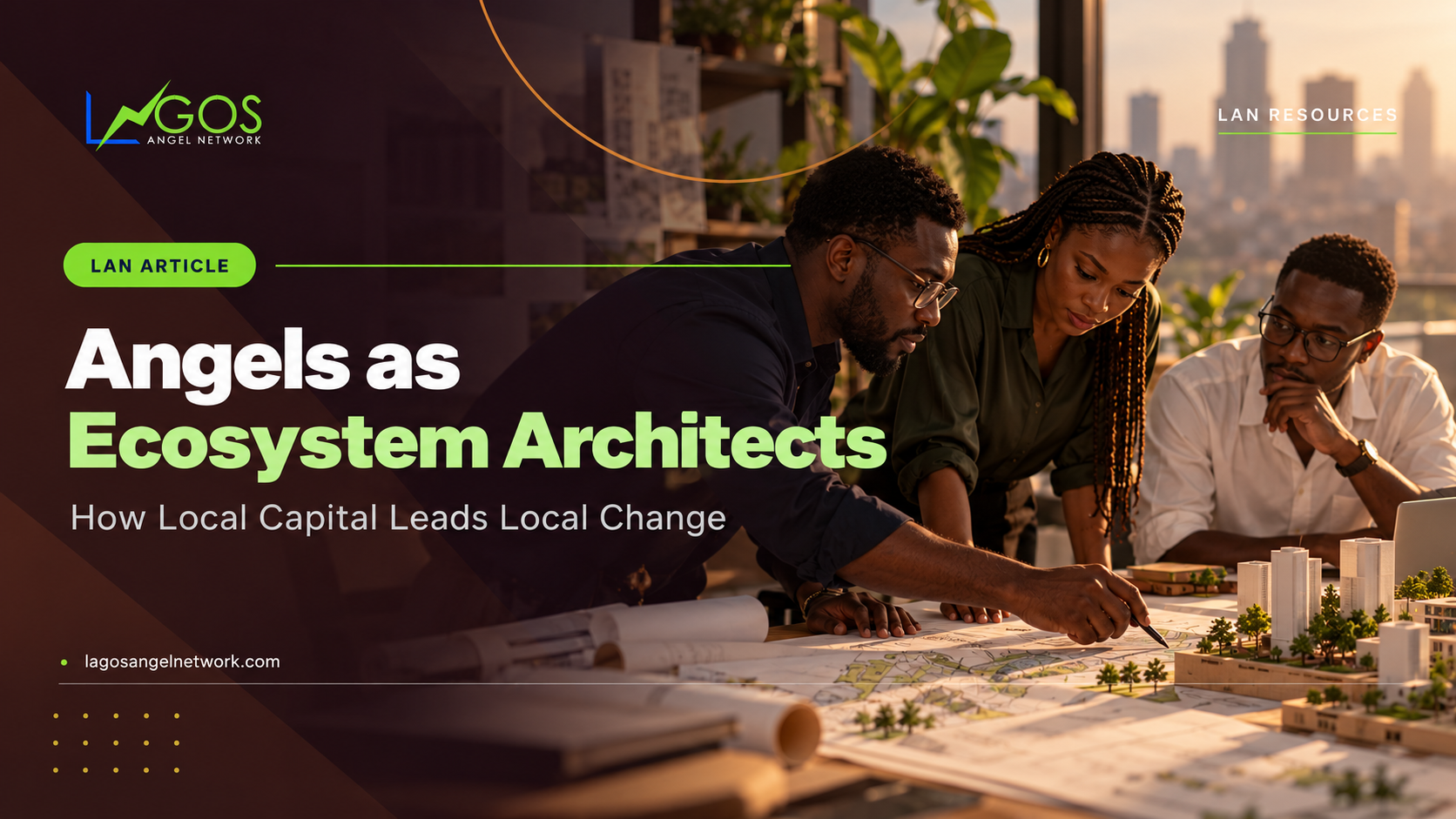
Angels as Ecosystem Architects: How Local Capital Leads Local Change
Africa’s startup ecosystem will not be built by foreign capital alone.
International venture capital has played, and will continue to play, an important role in accelerating growth, providing validation, and connecting African startups to global markets. But ecosystems that endure are not imported. They are constructed, patiently and deliberately, by those who live within them.
This distinction matters because international capital, while valuable, remains structurally limited. Africa continues to receive less than 2% of global venture capital, despite accounting for a far larger share of global population growth and unmet market demand. In such an environment, local capital is foundational
A sustainable startup ecosystem is not the product of capital flows alone. It is the result of local conviction, applied over time, through structures that outlast individual deals. This is where angel investors matter most, not merely as early funders, but as ecosystem architects.
At the Lagos Angel Network (LAN), we have seen this dynamic unfold up close. We have seen what changes when local capital moves beyond cheque-writing and begins to shape the underlying architecture of the market itself.
What emerges is not just better startups, but a more resilient ecosystem.
Beyond Capital: The Real Work of Ecosystem Building
Angel investors who shape markets operate on multiple layers simultaneously. In Lagos, a city defined by volatility, creativity, and relentless ambition, this work tends to concentrate around four critical pillars.
1. Mentoring First-Time Founders, and Enforcing Early Governance
In Lagos, startups rarely fail because founders lack ambition or ideas. They fail because early decisions compound quietly: messy cap tables, weak financial discipline, informal decision-making structures, and governance gaps that only surface when institutional capital begins to scrutinise the business.
Local angels are often the first and only line of defence against these failures.
Beyond mentorship, experienced angels help founders install discipline early, establishing board norms, separating personal and company finances, enforcing cap table hygiene, and grounding growth plans in unit economics rather than optimism. This work is unglamorous, but decisive. It is the difference between a startup that scales and one that collapses under its own complexity.
Crucially, Lagos founders face constraints that no imported playbook fully addresses: currency volatility, regulatory unpredictability, infrastructure gaps, and the constant pressure of global remote talent markets. Local angels understand these realities because they operate within them. Their guidance is not theoretical, it is situational, lived, and adaptive.
This is architecture at the foundation level. When done well, it is invisible. When absent, everything above it eventually cracks.
2. Backing Founder Education as Market Infrastructure
Strong ecosystems invest in people before they invest in deals.
Angel-backed bootcamps, founder education programmes, and operator-led accelerators serve a function far deeper than training mechanics. They create shared language, common standards, and networks of trust across cohorts of founders who will build, fail, rebuild, and eventually mentor others.
In Nigeria, angel-supported education initiatives have consistently produced founders who are more capital-ready, more operationally grounded, and better able to engage institutional investors when the time comes. These programmes do not just improve pitch quality; they improve decision-making under pressure.
When angels fund founder education, they are not chasing immediate returns. They are investing in ecosystem throughput, increasing the number of founders capable of building durable companies in difficult conditions.
Over time, this compounds. Better founders attract better capital, which raises expectations across the market. This is how standards are set without regulation.
3. Building Trust Circles That Enable Second Chances
Innovation requires tolerance for failure. Ecosystems without second chances eventually stagnate.
In Lagos, failure is rarely clean. Companies collapse not only because of execution errors, but due to policy shifts, currency shocks, supply chain disruptions, or sudden changes in consumer behaviour. Evaluating a founder solely by the outcome of a failed venture misses the more important question: how did they fail?
Local angels are uniquely positioned to answer this.
Within trusted networks, angels observe founder behaviour over time, integrity under stress, treatment of employees, responsiveness to feedback, and willingness to learn. This forms a layer of reputation capital that no remote diligence process can capture.
When these trust circles function well, they enable capable founders to return stronger, rather than exit the ecosystem entirely. Many of the most effective operators are not first-time successes, but second- or third-time builders who were backed again when the spreadsheet alone did not justify it.
In low-trust environments, this function is not optional. It is the social infrastructure that keeps talent circulating instead of disappearing.
4. Shaping Policy, Capital Formation, and the Bridge to Institutions
Angels do not only operate at the company level. Over time, organised angel networks begin to influence the rules of the market itself.
Across Africa, angel-led advocacy has contributed to improvements in tax treatment, investment frameworks, and regulatory engagement with the startup economy. These shifts do not happen spontaneously. They are the result of sustained, credible engagement by investors who have capital, context, and long-term commitment to the market.
In West Africa, angel syndicates are increasingly formalising into micro-funds and structured vehicles. This evolution matters. It creates pathways for domestic institutional capital, pensions, family offices, and corporate balance sheets, to participate in early-stage investing with clearer governance and risk profiles.
Equally important is the bridge role local angels play between Lagos realities and global capital expectations. Angels translate currency risk, regulatory friction, and informal market dynamics into operational narratives that institutional investors can underwrite. In doing so, they do not just fund startups, they de-risk assets for the global market.
This translation function is often invisible, but it shortens diligence cycles, improves follow-on outcomes, and anchors foreign capital more securely in local reality.
What Market-Making Actually Looks Like
Market-making is not a single intervention. It is a pattern of behaviour over time.
It looks like backing founders before they meet imported definitions of “investable.”It looks like insisting on governance before growth.It looks like funding education with no immediate upside.It looks like backing the right people again, even after visible failure.It looks like patient capital structures that recognise that liquidity in Lagos may follow different paths, secondaries, strategic acquisitions, or long-horizon compounding, rather than compressed Silicon Valley exit timelines.
This work is slow. It does not produce headlines. But it produces ecosystems that survive cycles.
Building From Within
Foreign capital will continue to have a seat at the table. But the table itself, the norms, trust networks, standards, and institutions, must be built locally.
The future of African innovation will be shaped by those who invest before certainty, enforce structure before scale, and remain committed when conditions are hardest.
This is the work of ecosystem architects. And it is work that must be done from within